
Productivity vs Wellbeing: Workplace Culture in Japan and The United States


Read this blog post to learn more about:
How cultural norms shape whether psychological strain is externalised collectively (Japan) or internalised individually (United States), and the implications for long-term sustainability.
Japan’s collectivist and the United States’ individualist work cultures, focusing on how each sustains productivity and distributes psychological cost.
Measurable outcomes such as burnout, stress, suicide rates, working hours, and productivity to evaluate mental wellbeing alongside economic performance.
This post will examine and compare Japan’s collectivist approach with the United States’ individualist's approach when working, and overall measure which country carries the most amount of psychological cost due to their own work culture. Initially, Japan's workforce estimates show some of the highest rates of suicide and burnout among other industrialised nations, despite the country's reputation for efficiency and discipline in the workplace. In contrast, the United States encourages individual freedom, flexibility, and independence when it comes to employment, but there are still situations that exacerbate inequality and mental health issues among American workers.
For this research, a collectivist employment model refers to workplace norms that prioritise respect and group loyalty per individual prioritisation and state ownership. (1993, Earley P.C) These values are especially noticeable in Japan’s corporate culture through their higher levels of job insecurity, inequality and performance-related pressure, challenging the assumptions that individualism inherently improves mental wellbeing. (2023, Atsushi Narisada ) Furthermore, this project will evaluate their flexible labour markets, competitive career progression and highlight the personal success. Additionally, in this investigation, wellbeing will not only be defined as momentary happiness, but rather as a concept which includes mental health outcomes, long-term psychological sustainability and work-life balance, focusing on definitions from the World Health Organisation. Instead of curating a comparative analysis of which country offers a better work culture, this paper is a research project that will compare measurable outcomes. For example, well-being is assessed through mental health outcomes, such as burnouts, stress levels and suicide rates, while productivity is used to compare through diagrams and graphs of average working hours, output per worker, as well as efficiency. Moreover, this paper will include the analysis of whether both these countries' structural expectations, for example, cultural pressure and their norms effect their productivity or their mental wellbeing as countries are facing rising levels of burnouts, unstable mental health and shifts in expectations in work in the post-pandemic era, both Japan and the United States offer influential models for developing countries' future employment structures.
This paper will evaluate the psychological costs associated with productivity in both countries by analysing how productivity is experienced by workers through national work cultures, through a comparative analysis, examining how each country’s historical, social and economic factors develop the country's own distinct work culture.
Societal perceptions of productivity differ between the United States and Japan, highlighting how work, effort, and success are appreciated within each system. Examining these contrasting definitions of productivity is essential for understanding how cultural expectations influence both economic output. Societal perceptions of productivity in the United States and Japan are directly compared to illustrate their impact through earlier case studies. To begin with, defining all the different types of productivity, for example, productivity in the workplace, productivity as a moral virtue and productivity as a national identity. Firstly, the economic definition of productivity is ‘Workforce productivity is the amount of goods and services that a group of workers produce in a given amount of time.’ (OECD (n.d.)). Even if the OECD definition is often agreed with, it mainly concentrates on the economic output and potentially undermines the psychological results, which are central to this investigation. Productivity does not only have be understood in terms of efficiency but can also be understood as a virtue and apart of national identity. According to academic sources ‘Individualist culture attaches social status rewards to personal achievements and thus, provides not only monetary incentives for innovation but also social status rewards, leading to higher rates of innovation and economic growth.’ (2011, Gorodnichenko, a,b, Roland, P.1)
Figure 1. (OECD, 2025) graph measuring GDP
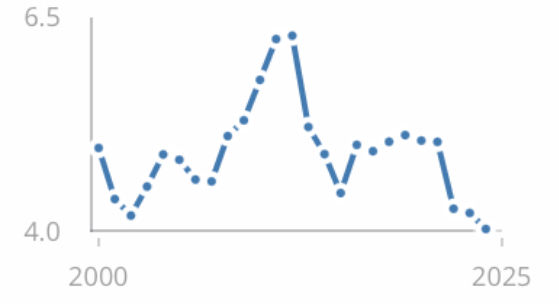
Figure 1. Illustrates Japan’s growth rate in real GDP over time. This is significant as a constant increase in GDP levels suggests success (OECD (n.d.)), yet it does not reflect the workers experiences in terms of wellbeing. Therefore, GDP provides an indicator of economic output, however, it may not include the efficiency of labour as there could be many underlying cultural and social factors which produces psychological strain. Moreover, productivity has evolved differently across different countries, specifically Japan had the most dramatic economic developments during the post war period. (1991, Robert E. Hite, Jon M. Hawes, P.1) . Although this graph shows an increasing GDP, it measures the output and does not consider the mental well-being of the workers which potentially overstates the economic success, as it does not reflect on the psychological costs of productivity.
Figure 2. - Growth Rates per Manufacturing Branch in Japan. (OECD)

Above is figure 2. which assesses Japan's growth of output and productivity for manufacturing, especially throughout the post-war period. Despite having experienced a serious decline in the second half of the 1970s, in five other industries (steel, car parts, cars, metalworking, and consumer electronics) Japan was more productive. (Bart van Ark, Dirk Pilat, Dale Jorgenson, Frank R. Lichtenberg,1993) this is crucial regarding the investigation because this visible growth would've been achieved from intense labour reinforcing the high-pressure that the workers would've felt to achieve these positive results. (Everette S. Gardner, Jr., John M. Ivancevich, 1994) Although Japan has experienced periods of productivity stagnation, evidence implies a more resilient and adaptive economy than is often portrayed, which is reinforced in the OECD Analysis which indicated that the economy remains quite resilient amid global headwinds due to the business sentiment robust especially in non-manufacturing. This implies renewed confidence in the service sector, which dominates Japan's economic structure. Significantly, policy makers acknowledge that “rebuilding fiscal buffers and boosting potential growth are priorities,” and “addressing demographic headwinds requires further increasing labour supply and reinvigorating productivity growth,” highlights that Japan's productivity is increasingly understood as structural rather than cyclical. (Bart van Ark, Dirk Pilat, Dale Jorgenson, Frank R. Lichtenberg,1993) overall, this indicates that even if demographic constraints remain significant, Japan's productivity is influenced by capacity for labour market adjustment, not only by long-term stagnation. Yet, this interpretation assumes that GDP is solely driven by labour intensity, even when it could potentially mirror the technological advancements meaning that strain and burden is not inferred from output data alone.
FIGURE 3. Business sentiment is robust, in manufacturing in Japan (OECD)

In addition to this, Figure 3. reinforces that business sentiment has strengthened significantly in non-manufacturing sectors since 2021. Given that services account for the majority of Japan’s economic output, rising confidence in this sector suggests improved investment prospects and potential productivity gains. However, sentiment indices measure expectations rather than realised output per hour, meaning the graph indicates future productivity potential rather than current productivity performance. Nonetheless, the sustained upward trend supports the argument that Japan’s productivity challenge is increasingly structural rather than cyclical. Together, the strengthening of business sentiment and rising nominal wages imply that Japan’s productivity trajectory may increasingly depend on private-sector adaptation rather than solely demographic reform. (2025, page 199, volume 118, OECD) however, this does not automatically translate to an improved worker well-being, as this increased expectation would have only increased pressure on employees to meet future growth targets.
FIGURE 4. - Nominal Wages in Japan (OECD)

Figure 4. shows that nominal wages have risen steadily since 2022, reflecting tightening labour market conditions. In the context of persistent labour shortages, rising wages may incentivise firms to adopt efficiency-enhancing technologies tomaintain profitability. This illustrates the disconnection between actual and potential improvements, suggesting that workers still could feel financial stress causing over-work, proving how not all data captures employee's financial insecurity. (2025, page 199, volume 118, OECD) Japan’s recent productivity challenges can be partly explained by the structural demographic and institutional factors. However, the work status from 1999 claims that ‘Being employed was estimated as a function of age, education, health, family characteristics, home ownership, and living arrangements.’ As implied in older workers and national productivity in Japan (2008), Japan had experienced a rapid population ageing and a declining working-age population, reducing the effective labour supply and places pressure on national output.
In the USA, productivity is seen as an individual aspect (2025, Tyson, Lipka & Deane, p.5), and is measured through personal targets, social pressures and freedom. Figure 8. illustrates the Growth Domestic Product (GDP) in the United States overtime. This figure below shows a clear increasing trend, implying the increasing overall economic output of its economy since the early 2000’s. This rising GDP mirrors the improvement in productivity because as businesses become more successful, output increases so GDP grows. Overall, this figure highlights how the economy of US is able to sustain productivity overtime.
Figure 8. (OECD 2025) GDP IN USA

In the figure below, Figure 9. portrays research and development (R&D) expenditure as a percentage of GDP in the United States, revealing how the Unites States consistently invests a large proportion of its GDP into R&D. This is key for innovation and development for productivity within the US economy. Overall, improving efficiency that contributes to high labour productivity. In contrast to this, it may intensify workers expectations. (Earley, 1993)
Figure 9. (OECD, 2025) R&D in USA

In addition to this, due to Covid 19, there was a long-term structural change (hybrid productivity model). Additionally, this hybrid model could blur boundaries between work and personal life, contributing to the strain employees experience.It was claimed by the Pew Research Centre that “Now, 43% of workers say they have this type of hybrid schedule.” By April 2020, the unemployment rate reached 14.4%.’ (Amelia, 2026) Which reduced overall economic output and interrupted business. (2025, Tyson, Lipka & Deane, p.5) However, historically it is claimed that ‘Cumulative US Labor Productivity Growth Has Exceeded Pre-COVID Levels Since 2020’ also, the gradual process of workers being re-hired post pandemic. Productivity is highly important, specifically for the USA, because ‘Productivity increases have enabled the U.S. business sector to produce nine times more goods and services since 1947 with a relatively small increase in hours worked.’ (n.d, U.S, bureau of Labour Statistics.) Overall, this proves how the psychological cost of productivity is internalised, due to the workers being expected compete and adapt within an insecure labour market.
Figure 8 – output, hours and labour productivity indexes in the nonfarm buisiness sector 2007-2020. (Bureau of Labour Statistics)

In addition to this, when analysing figure 8. the graph shows that the United States’s productivity rose in 2020, exceeding its pre-pandemic trend. This sudden increase portrays how things such as the economic shock in covid-19 temporarily boosted productivity, this could potentially be because of the change in working patterns, for example, people often had to work from home leading to significant increase in the adoption of technology. Yet this rise was clearly not sustained, because by the beginning of 2023 productivity had fallen towards its previous long-term trend. Overall, this indicated that these changes did not lead to sustainable productivity gains. Yet from this figure the United States appears adapt to a one considering short-term efficiency although it proves that it's not necessarily efficient in the long-term. Reinforcing how these aims and tasks are only obtained when the employees are over-worked from internalised pressure, adding to the psychological cost of workers in the United States. (Gordon, 2012, p.9)
Overall, the data illustrates how COVID-19 caused a structural shift in work patterns, with long-lasting implications for productivity, work culture, and the organisation of labour. So, this information is why productivity is what it is now in the USA and how it was when the significant pandemic occurred, as it mostly affected the levels of productivity and the work culture. Additionally, in the United States their psychological burden may be overlooked as it is less acknowledged than Japan’s longer working hours.
Japan’s collectivist work culture is understood as a response to economic instability rather than a purely cultural tradition. (Todeschini, 2011, p.20) Post-war reconstruction required rapid industrial growth, and this incentivised employment systems that prioritised loyalty and collective effort as mechanisms for productivity. (Maya Morioka Todeschini (2011) pp. 4–24) This didn't just suddenly develop in the Japanese work culture, post-World War II, corporate businesses needed to set up systems, such as lifetime employment and seniority-based advancement, so that they would solve job insecurity by securing jobs in exchange for pure devotion to their companies, ultimately leading to job loyalty becoming an economic and social norm. This had to occur rapidly because Post-war, rapid industrialisation relied on committed workers , which was often portrayed as extended working hours and employer loyalty. (Maya Morioka Todeschini (2011) pp. 4–24) This translated to expectations of workers to do long unpaid overtime, inability to leave before a senior colleague or being dismissed. For example, Typical “salarymen” who were full-time workers who stayed with one company for most of their careers. (Vogel, E.F. (1979)) Usually, embody these norms, as their professional reputation often depends on visible effort, including participating in after-work socialising and prolonged office hours. So that Japanese workers were able to emphasise their determination and demonstrate their commitment. The article discusses the concept of "Three Sacred Treasures" in Japanese management, which includes lifetime employment and promotion by seniority.’ (2011, Maya Morioka Todeschini, p.5) These practices are seen as solutions to job insecurity and signify a lifelong commitment to the company, which in turn is responsible for the well-being of its members. Additionally, it mentions that ‘these practices were partly eroded due to the economic crisis of the 1990s, but they continue to play a vital part in Japanese HR management today’ (2011, Maya Morioka Todeschini, p.5) Although it says that these practices were mostly reduced during the economic stagnation of the 1990’s, the enduring cultural importance of loyalty and collective responsibility is said to still be present to this modern day. (van Ark and Pilat, 1993, p.50) As well as this, important aspects of the work culture in Japan based off traditional Japanese society. (Norbury and Bownas 1978) For example, ‘Politically plurist, authoritarian, communal, nationally egoistic, Hierarchal, assertive attitude toward environment, persuasive attitudes and values and competent perfective technology.’ (Norbury and Bownas 1978) Additionally, in Japan, societal expectations ultimately formed the Japanese work culture of working for long hours, deep loyalty to older and respected members and to the company, as well as this economic success aligned with productivity, moral duty and their contribution to society. (Bart van Ark, Dirk Pilat, Dale Jorgenson, Frank R. Lichtenberg,1993) These factors, being both cultural and institutional, help to explain why productivity in Japan is historically perceived not just as output, but as a reflection of a worker’s moral duty and collective success. This is a perception that differs from more individualistic, output-driven models seen in countries such as the United States. However, as expected, this difference has led to a detrimental health issue which will be referred to as the ‘psychological cost’ of working overtime due to the societal expectations in Japan.
While productivity is often celebrated for its economic benefits, its psychological consequences are less visible and frequently normalised. In Japan, however, these costs are explicitly acknowledged. A clear example of the psychological consequences of productivity-driven work culture can be seen in Japan through the case study of ‘karōshi’, which translates to ‘a Japanese term that translates to "death from overwork," highlighting a serious issue within Japan's work culture’ (Atsuko Kanai, 2009, Vol. 84, Supplement 2) As the government has a formal term for death and serious illness caused due to overwork, illustrating that is isn't a cultural preference, instead a societal issue. There is also ‘Karojisatsu’, which is defined as ‘suicide from overwork and stressful working conditions’, also becoming a ‘social issue in Japan since the latter half of the 1980s.’ (2013, International Labour Organisation, p.1.) Furthermore, both reinforce the illustration of how cultural expectations about productivity can manifest in measurable health outcomes. For example, long overtime and intense job demands are linked to increased stress and heightened risk of cardiovascular problems, which contribute to the fatal outcomes classified as karōshi and Karojisatsu. (Atsuko Kanai, 2009, Vol. 84, Supplement 2) the link between long working hours and the outcomes are visible below in figure 5.
Overall, contributing to stroke and heart disease elsewhere, too. Therefore, while karōshi is in Japan due to cultural norms and social recognition, it also reflects a broader global issue concerning the psychological costs of excessive work expectations, which strengthens its usefulness as a comparative case study rather than an isolated anomaly.
Figure 5- depression and anxiety in relation to weekly working hours (World Health Organization)
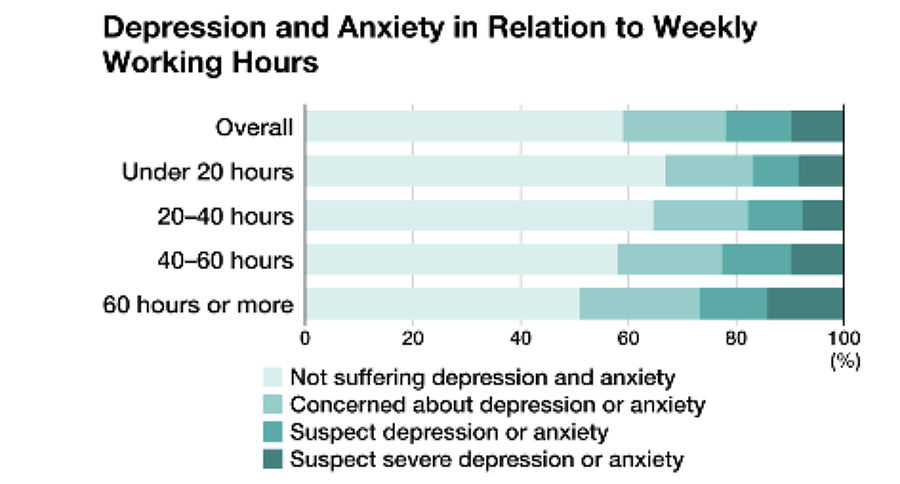
Figure 6- Graph presenting Karoshi and or mental disorders (Ministry of Health Labour)
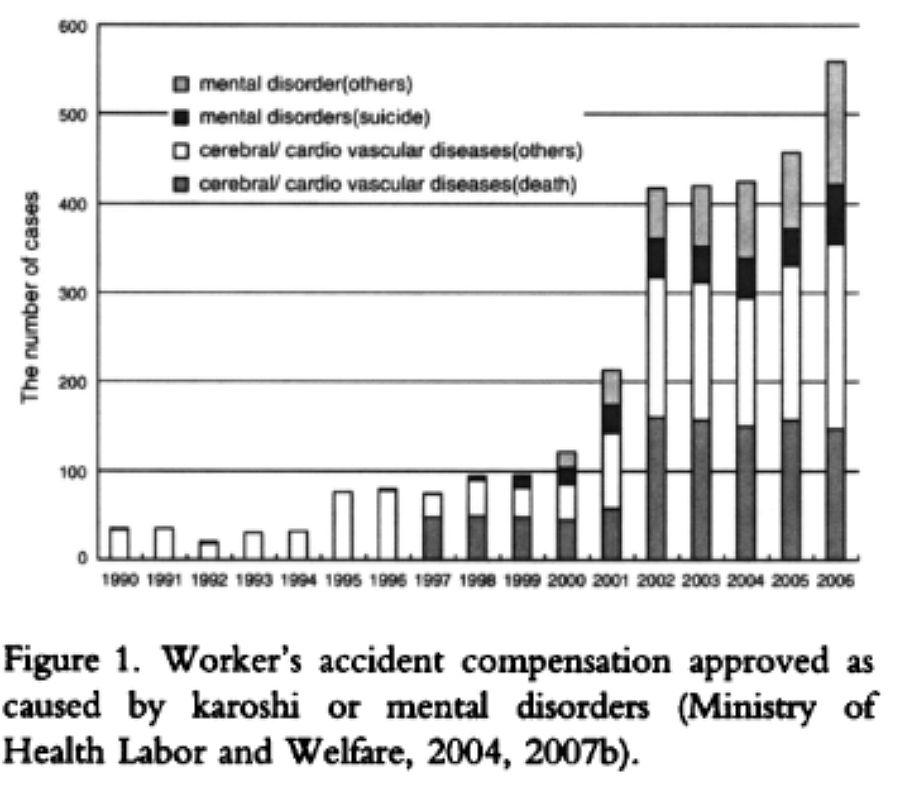
In the late 90’s, the number of cases with excessive labour had increased shown in figure 6,, supporting the argument that prolonged hours are a psychological and physiological risk factor as well as an economical issue.(Atsuko Kanai, Vol. 84, Supplement 2: Working to Live or Living to Work (2009))
Figure 7 – comparison of total annual hours worked by country (Ministry of Health Labour)

In comparison to other countries, figure 7 it shows that in Japan, annual working hours have historically been longer. The persistence of long work hours stems from the socitel pressures and Japan’s work culture. (Atsuko Kanai, Vol. 84, Supplement 2: Working to Live or Living to Work (2009))
Through studying Karoshi, it reveals deeper cultural expectations within the Japanese employment systems, where these long hours have become normalised as they prove commitment. Research highlights how overtime hours when working increases the risk of depression and anxiety, supporting the argument that excessive work contributes to psychological and physical harm. Overall proving that Karoshi is the end result of the prolonged psychological and physical strain.(Atsuko Kanai, Vol. 84, Supplement 2: Working to Live or Living to Work (2009)) However, these statistics may underestimate the scale of overwork-related deaths as cases may go unreported or fail to meet legal criteria for recognition.
In the United States of America, there are clearly defined values such as individualism, meritocracy and hard work. Work culture is defined as ‘the shared values, norms, practices, and behaviours that define how an organisation operates and how its employees engage with one another’ (Achieving work‑life balance varies with workplace practices and individual circumstances (Sánchez‑Hernández, 2019).) However, ‘work-life balance in the United States can vary greatly depending on the industry and organisation.’ (2025, Natasha Amelia, p. 1). The “free enterprise system encourages creativity,” (2025, Natasha Amelia, p. 1). This idea motivates employees to excel and contribute new ideas while balancing teamwork with individual accountability. Workers are encouraged to take ownership of their roles, which is reflective of a culture where “individuals take ownership of their tasks while working towards collective goals.” ((n.d.) American business culture: What international professionals must know.) Employees in the USA are passionately committed to their jobs, and as a result work with large amounts of pride and dedication as is shown through their daily efforts. A competitive environment forces people to “seek recognition and strive for personal and professional growth,” ((n.d.) USA business culture) strengthening improvement. Whilst most companies are hierarchically structured, their employee-manager relations are seen as more approachable and open. "The focus on openness and directness of communication gives greater freedom to ideas and feedback, resulting in a transparent environment where employees feel respected and listened to.” Generally, working in America demands “a strong work ethic, adaptability, and the drive for continuous improvement,” (2022). According to workers, culture drives both productivity and innovation, as well as customer service which celebrates both individual and collective success. As reflected in (Eagle Hill Consulting (2023), a large share of U.S. workers say company culture drives these factors such as productivity and innovation etc. New Eagle Hill research finds [online], PR Newswire, 19 September.) claiming that 72% of U.S. workers say their workplace culture drives productivity and efficiency, and 64% say it drives innovation. This ultimately shows that there is a clear link between culture, communication, and performance. However, studies have consistently shown that flexibility for USA workers has often had detrimental effects such as ‘Worklife conflict, stress and anxiety’ (2014, E Gordon, P.1) Yet, these sources claim that these negative consequences only come about in the presence of an “unsupportive workplace culture”, where “workers are expected to work long, overtime hours or specific set hours a day”.(2014, E Gordon, P.1) Moreover, this journal claims that there are things known as FWPs, which stand for ‘flexible workplace practices’ which aim to ensure wellbeing in working environments. However there are some cons of the FWPs, such as the fact that not all flexibility options are being evenly distributed among employed workers. This argues that mostly really only managers and professionals obtain FWPs. The journal article ‘Flexible Workplace Practices: Employees' Experiences in Small IT Firms’ claims that ‘most employed individuals will avoid the use of FWPs out of fear of negative career repercussions’ (Higgens et al., 2008; Hochschild,1997; Lewis and Smithson 2009, Thompson et al., 1999), because when time oriented workers are prioritised, a workplace culture subsequently becomes unsupportive.
Both the ‘individualist’ and ‘collectivist’ approaches to work influence both countries’ culture, behaviour, and their productivity. Research shows that individualistic societies such as the United States often emphasise personal autonomy and innovation which encourages creativity and individual initiative in the workplace. (Eisenberg, 1999) The common characteristics of individualists are the prioritisation of self-achieved awards and hitting personal goals. This directly contrasts the collectivists who prioritise harmony, loyalty and shared responsibility. (Smith, 2015) Furthermore, James Waititu, claimed that American Individualism was founded on several elements: ‘One element which has to do with American Individualism is constituted of two different aspects: America being a unique culture in itself and Americans being Independent Individuals. Secondly it may be the notion of Independent Individualism that is concerned with individuals rather than society as a whole; Thirdly a part of that may be the Protestant Ethic which was developed by John Calvin, Martin Luther and Pilgrims who came to the New World to practice religious freedom; Transcendentalism, a philosophical movement in the 1830s and 1840s in New England; The American Dream concept is the fifth element; that America was founding a democracy unlike most European nations including that of England; Seventh a part may be the idea of capitalism and a free, market society;’ he also wrote that ‘An Independent Individual is another name for a typical American.’ Nevertheless, the fact that American culture is so distinctive and so deeply embedded within the country offers people the freedom to express themselves in whatever way they would like. However, it has been noted by research that Confucian philosophical traditions affected Japanese social norms at a very deep level, with the main emphasis placed on loyalty and harmony within the group. Subsequently, these values slowly began to move towards corporate structures like lifetime employment, and consequently establishing an ultimately collectivist work culture. Ultimately, Japan’scontinued reliance on social hierarchies within the workplace reinforces the repeated ideals of collective responsibility and loyalty. This philosophical viewpoint has traditionally been stereotyped within the U. S. capitalist economy, where productivity is a result of performance and is based on rewards and the success of the individual. And whilst this might be good for innovation, it results in productivity spikes at the cost of job security and workforce stability. (Shanafelt, Ripp and Trockel, 2020, p. 2133) On the other hand, Japan's collectivist mentality has led to employment practices such as the provision of lifetime jobs and strong corporate loyalties which enabled productivity, especially during Japan's post-war economic boom. Hence, both philosophies shape productivity but in contrasting ways, as the changes are influenced by the unique cultural and historical backgrounds.
United States is commonly known for its individualist approach to labour, yet it is argued that due to the rise of neoliberal economics as well as the decline of job security, both these things influence a high psychological cost. Neoliberalism can increase loneliness and compromise our well-being by promoting a sense of social disconnection competition and loneliness. (2021, Julia C Becker, Lea Hartwich, S alexander Haslam) this highlights the difference between how jobs insecurity was experienced in the past and how it is experienced in present day which is known as the ‘shift in nature of job insecurity’. Furthermore, job insecurity has moved from mass unemployment (1930s) to precarious employment despite high employment levels, shows how employment statistics can mask real economic insecurity. (2023, Hugh Collins, P.1) Many workers are in between jobs or in precarious jobs that have irregular hours short-term contracts low and no guarantees on their future income. (Becker, Hartwich and Haslam, 2021, p.948) The insecurity is so common that these workers can hardly think about planning their future or trusting Social Security systems. (Lammers et al., 2016, p.450)This article from the ‘LSE public policy review’, raises the contrast between ‘flexibility vs insecurity’, however flexibility (choosing hours) is not the same as insecurity (not knowing if work exists). The main point the author is making is that most of the workers desire job security, mainly because a steady income as it is claimed that because most people desire to have control over their own lives and being able to achieve their personal satisfactions. (2016, Joris Lammers, J.I. Stoker, F. Rink, and Adam Galinsky
Figure 9. (workplace suicides in United States- Bureau Labour of statistics)
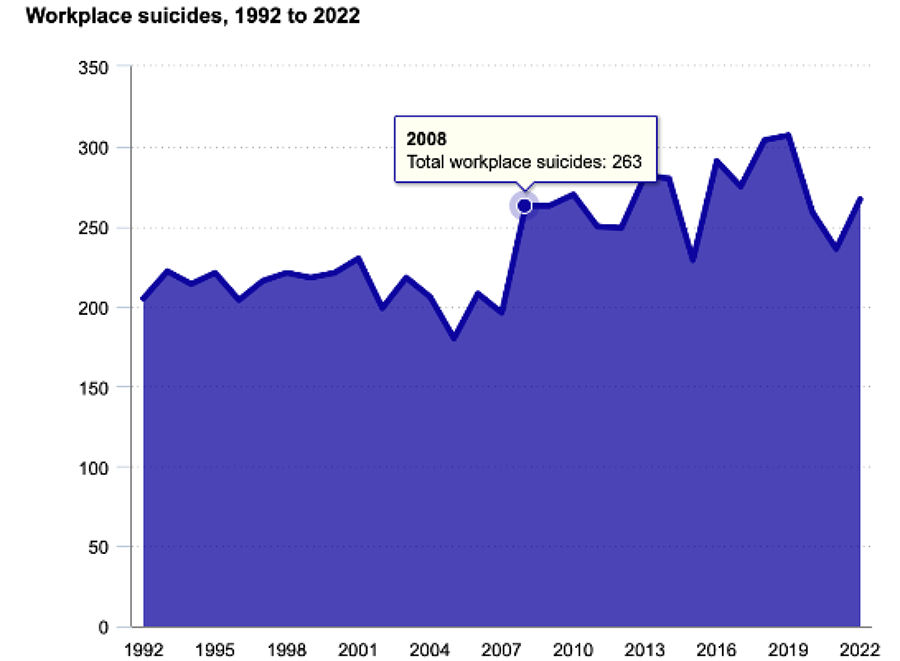
From the figure above, it can be noted that although the suicide rates fluctuate, by 2022 they remain steady and decently high in comparison to 1992. These figures illustrate how there could potentially be a systematic issue within the labour market of the United States, which reinforces how this is not just an isolated problem. Overall it is important to note how this graph emphasises that stress within labour is deeply embedded into their work culture. The ‘American Psychological Association” conducted research which concluded by saying 57% indicated experiencing negative impacts because of work-related stress that are sometimes associated with workplace burnout examples or burnouts being, emotional exhaustion (31%), didn’t feel motivated to do their very best (26%) and the one this project will mainly focus on, as it seems to be overlooked is a desire to keep to themselves (25%) and feelings of being ineffective (18%) leading to a desire to quit (23%). From this research, these figures reinforced how work-related stress is a systematic issue within the labour market which masks the true extent of insecurity present within the average worker. Overall, this implies how in the United States employees may have internalised psychological strain ,which specifically can be manifested as constant job insecurity as well as work-pressure, as a result of this, it reinforces how workers have to continuously self-regulate to compete to remain employable.
However, to conclude, this project compares which country, from the United States and Japan experiences the highest amount of psychological cost from labour. The difference between Japan and the United States are the work cultures which gradually enforce the disruption of the workers mental health in both, Japan and the United States. From analysing the countries’ workplace norms, cultures, productivity and GDP measures as well as their health outcomes, it is overall visiblethat both countries experience a ‘cost’ regarding their employee’s health however the two vary in what the causation may be. For example, the mental health burden exists in both countries, yet it is experienced differs due to what their individualistic or collectivist approach to work is.
Specifically, in Japan, their collectivist approach to labour is embedded in their work culture, overall normalising their excessive approach to work as well as their self-sacrifice due to their cultural and workplace norms as showing visible effort becomes a societal expectation. Which reinforces the societal expectation that personal suffering contributes to collective success and economic stability. Most resources linked this excessive, societal-driven satisfaction to increased risks of depression and suicide and additionally demonstrates that Japan’s psychological cost is socially produced and collectively distributed. This implies that Japan’s work environment is socially recognised for its psychological cost and this cost is externalised through collective norms, meaning that they do not see overwork as the capitalist system exploiting them.
In contrast to this, the individual in the United States sees productivity as a personal reflection of their own merits, ambition, and freedom. This system can encourage workers to be innovative anf flexible to boost their individual success, but on the other hand, it also brings about insecurity through uncertain jobs and constant pressure to perform even amidst unfair privileges in access to flexible work arrangements. In this system, psychological costs are internalised within workers encouraged to interpret exhaustion as personal failure, rather than the result of systemic labour conditions.
Lastly, through this comparative analysis it is evident how productivity is significantly sustained through economic and technological means. Whilst neither Japan or United States differ from how the psychological cost is imposed on each worker, they differ in how these costs are absorbed by their workers. Additionally, through researching it has raised multiple questions regarding the long-term sustainability of both of these systems as well as if it is even possible to balance the importance of mental health and efficiency. The difference between Japan and the United States is the mechanisms which are produced by each country: Japan externalizes the workers psychological cost through duty and conformity, whereas the United States internalises the strain through the personal tie and responsibility as well as the competition. Therefore, both of these mechanisms produce different types of workers, whether they are compliant and self-sacrificing workers in Japan, or self-blaming in the United States; the limits of social security systems in both countries exacerbate these effects. Welfare systems typically assume regular monthly income and stable employment, allowing them to not be equipped to support each worker who face, fluctuating hours and insecure contracts. This highlights a structural failure to mitigate psychological harm in both models.
Bibliography:
Amelia, N. (2026) US work culture in 2026: 8 characteristics you need to know. EdStellar. Available at: https://www.edstellar.com/blog/american-work-culture
American Psychological Association (2023) Work in America: 2023 workplace health & well-being. Available at: https://www.apa.org/pubs/reports/work-in-america/2023-workplace-health-well-being
Becker, J.C., Hartwich, L. and Haslam, S.A. (2021) ‘Neoliberalism can reduce well-being by promoting a sense of social disconnection, competition, and loneliness’, British Journal of Social Psychology, 60(3), pp. 947–965. doi: 10.1111/bjso.12438. Available at: https://doi.org/10.1111/bjso.12438
Collins, H. (2024) ‘Job security, precarious work, and freedom of contract’, LSE Public Policy Review, 3(2). doi:10.31389/lseppr.98. Available at: https://ppr.lse.ac.uk/articles/10.31389/lseppr.98 (Accessed: 15 March 2026
Columbia Business School (n.d.) Have control over or be free? Others’ desire for power reflects need for autonomy. Available at: https://business.columbia.edu/faculty/research/have-control-over-or-be-free-others-desire-power-reflects-need-autonomy
Congressional Research Service (2021) U.S. economic growth and productivity: background and issues. Available at: https://www.congress.gov/crs-product/R48528
Dore, R. (1973) British Factory–Japanese Factory: The Origins of National Diversity in Industrial Relations. Berkeley: University of California Press.
Eagle Hill Consulting (2023) Large share of U.S. workers say company culture drives productivity, innovation, and customer service, new Eagle Hill research finds [online]. PR Newswire, 19 September. Available at: https://www.prnewswire.com/news-releases/large-share-of-us-workers-say-company-culture-drives-productivity-innovation-and-customer-service-new-eagle-hill-research-finds-301939887.html
Earley, P.C. (1993) Further explorations of collectivistic and individualistic … (Article). Available at: https://www.jstor.org/stable/256525
EBSCO (n.d.) Karoshi. EBSCO Research Starters. Available at: https://www.ebsco.com/research-starters/law/karoshi
Eisenberg, E.M. (1999) Organizational culture and climate. In: Clegg, S., Hardy, C. and Nord, W.R. (eds.) Handbook of organization studies. London: Sage, pp. 256–292.
Gardner, E.S. Jr. and Ivancevich, J.M. (1994) ‘Productivity in the US and Japan: A reexamination’, Interfaces, 24(6), pp. 66–73.
Gordon, R.J. (2012) Is U.S. productivity growth over? International Productivity Monitor, 23, pp. 3–25. Available at: https://www.jstor.org/stable/24641863
Gorodnichenko, Y. and Roland, G. (2011) ‘Individualism, innovation, and long-run growth’, Proceedings of the National Academy of Sciences of the United States of America, 108(Suppl 4), pp. 21316–21319. Available at: https://pmc.ncbi.nlm.nih.gov/articles/PMC3271573/
Hite, R.E. and Hawes, J.M. (1991) Understanding the Japanese culture for business success. Journal of Managerial Issues, 3(1), pp. 31–45. Available at: https://www.jstor.org/stable/40603897
Institute for Social Capital (n.d.) Definitions of social capital. Available at: https://www.socialcapitalresearch.com/literature/definition/
Kanai, A. (2009) “Karoshi (Work to Death)” in Japan. Journal of Business Ethics, 84(2), pp. 209–216. Available at: https://www.jstor.org/stable/40294785
Lammers, J., Stoker, J.I., Rink, F. and Galinsky, A.D. (2016) ‘To have control over or to be free from others? The desire for power reflects a need for autonomy’, Personality and Social Psychology Bulletin, 42(4), pp. 498–512. doi: 10.1177/0146167216634064. Available at: https://doi.org/10.1177/0146167216634064
Lewis, S. and Smithson, C. (2009) Work-life balance: How organizations manage boundaries. Journal of Organizational Behaviour, 30(5), pp. 601–617.
Narisada, A. (2023) ‘Work stressors and the buffering functions of the sense of control in the United States and Japan’, Society and Mental Health, 13(2), pp. 131–150.
Nippon.com (2023) White paper on state of overwork in Japan highlights links to depression. Available at: https://www.nippon.com/en/japan-data/h01818/white-paper-on-state-of-overwork-in-japan-highlights-links-to-depression.html
Norbury, J. and Bownas, J. (1974) The Japanese Manager. London: Routledge.
Norbury, P. and Bownas, G. (1978) Business in Japan: A guide to Japanese business practice and procedure. 2nd edn. London: Macmillan.
Organisation for Economic Co-operation and Development (OECD) (2025) OECD Economic Outlook, Volume 2025 Issue 2: Resilient Growth but with Increasing Fragilities. Paris: OECD Publishing. Available at: https://www.oecd.org/content/dam/oecd/en/publications/reports/2025/12/oecd-economic-outlook-volume-2025-issue-2_413f7d0a/9f653ca1-en.pdf
Sánchez-Hernández, M.I. (2019) Work-life balance practices and employee wellbeing. Available at: https://www.ncbi.nlm.nih.gov/pmc/articles/PMC6950576/
Shanafelt, T.D., Ripp, J. and Trockel, M. (2020) Understanding and addressing sources of anxiety among health care professionals during the COVID-19 pandemic. JAMA, 323(21), pp. 2133–2134. Available at: https://pubmed.ncbi.nlm.nih.gov/33416201/
Smith, M. (2015) The origins and history of American individualism. Available at: https://www.academia.edu/13440953/The_Origins_and_History_of_American_Individualism
Thompson, C., Beauvais, L. and Lyness, K. (1999) When work-family benefits are not enough: The influence of work-family culture on benefit utilization, organizational attachment, and work-family conflict. Journal of Vocational Behavior, 54(3), pp. 392–415.
Todeschini, M.M. (2011) The ‘Three Sacred Treasures’ in Japanese Human Resource Management. Japan Labor Review, 8(1), pp. 4–24.
Todeschini, M.M. (2011) ‘“Webs of Engagement”: Managerial responsibility in a Japanese company’, Journal of Business Ethics, 101(Suppl 1), pp. 45–59. Available at: https://www.jstor.org/stable/41475876
Tyson, A., Lipka, M. and Deane, C. (2025) How COVID-19 changed U.S. workplaces. Pew Research Center. Available at: https://www.pewresearch.org/politics/2025/02/12/how-covid-19-changed-u-s-workplaces/
U.S. Bureau of Labor Statistics (2021) Productivity perspective of the 2020 COVID-19 pandemic. Available at: https://www.bls.gov/blog/2021/productivity-perspective-of-the-2020-covid-19-pandemic.htm
U.S. Bureau of Labor Statistics (n.d.) Why is productivity important? Productivity 101. Available at: https://www.bls.gov/k12/productivity-101/content/why-is-productivity-important/
U.S. Bureau of Labor Statistics (n.d.)
USA Business Culture (n.d.) American business culture: What international professionals must know. Available at: https://www.commisceo-global.com/resources/country-guides/usa-guide
van Ark, B. and Pilat, D. (1993) Productivity Levels in Germany, Japan, and the United States: Differences and Causes. Brookings Papers on Economic Activity, 1993(2), pp. 1–69. Available at: https://www.jstor.org/stable/2534737
Vogel, E.F. (1979) Japan as Number One: Lessons for America. Cambridge, MA: Harvard University Press.
Vogel, E.F. (1979) Japan as Number One: Lessons for America. Cambridge, MA: Harvard University Press. Available at: https://archive.org/details/japanasnumberone0000voge


Comments